Alternative gases in building services engineering: planning perspectives for bio-LPG, biomethane and hydrogen

What energy sources will be available in the future, and how can heating systems be designed to remain future-proof? This is becoming an increasingly important question for planners.
- Blog
- Expert - Engineer
Decarbonising the building sector requires solutions that are open to all technologies. Alongside electrification, alternative gases are becoming increasingly important – particularly in existing buildings. At the same time, European and national regulations are tightening the requirements for CO₂ reduction in the heating sector. It is not yet possible to say with certainty which alternative gases will be available regionally in the future. For planners, the question of how heating systems can be designed today to be as flexible and future-proof as possible is becoming increasingly important.
Alternative gases as a building block of sustainable supply strategies
The term ‘alternative gases’ refers to gaseous energy sources that are either derived from renewable raw materials or produced synthetically using renewable energy. These include, in particular:
- Biomethane
- Hydrogen
- Synthetic methane (power-to-gas)
- Renewable liquid gases such as bio-LPG or biopropane
From a planning perspective, it is particularly important that these energy sources can utilise the existing gas infrastructure to varying degrees. Buildings can therefore be decarbonised gradually, without having to completely replace existing heat distribution systems or energy infrastructure.
Availability of alternative gases in Europe: what planners should bear in mind
When it comes to strategic planning for future heating concepts, it is not only technical suitability that is crucial, but also the regional availability of energy sources.
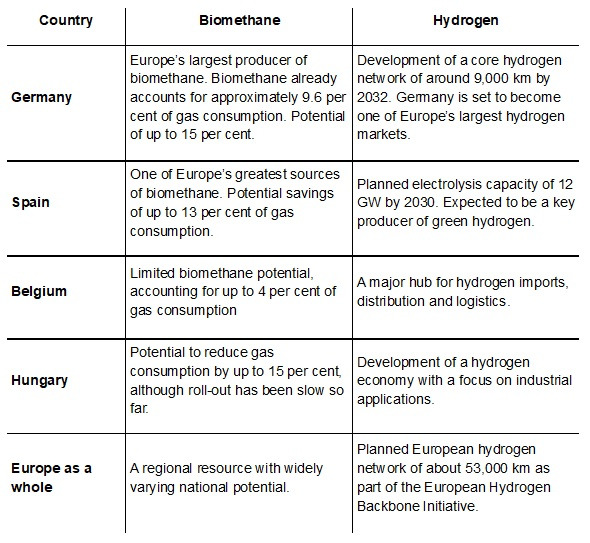
Availability of alternative gases in Europe
Findings relevant to planning
Whilst biomethane can be used without any technical modifications, the use of hydrogen depends largely on the expansion of the production and transport infrastructure. The ability of heat generators to use different energy sources is therefore becoming increasingly important.
Biomethane: the decarbonisation option available in the short term for existing buildings
Biomethane is produced by processing biogas and, in accordance with EN 16723, largely corresponds to the properties of natural gas. Existing gas networks and modern condensing boilers can therefore continue to be operated without the need for technical modifications.
Advantages:
- Direct use of existing infrastructure
- No adjustments to heat generators are required
- Significant potential for CO₂ reductions
- Available now
Challenges:
- Limited availability of sustainable raw materials
- Competition for biogenic residues
- Local emissions remain
For refurbishment projects involving high flow temperatures or where the scope for electrification is limited, biomethane represents one of the most pragmatic options for gradual decarbonisation.
Hydrogen: long-term planning perspectives and infrastructure developments
Hydrogen is regarded as one of the key energy sources for future energy systems. In the long term, it will be particularly relevant in applications where full electrification is not technically or economically viable
Advantages:
- A virtually unlimited supply of raw materials
- Potential for seasonal energy storage
- Low CO₂ emissions from green manufacturing
- A key component of sector coupling
Challenges:
- High demand for renewable electricity
- Lower energy content per unit volume
- Technical adjustments for high hydrogen content
- Dependence on future network infrastructures
Current certification standards assume that many modern heat generators are already capable of handling hydrogen blends of up to 20 per cent. In addition, new hydrogen infrastructure is being developed across Europe, which is intended to enable wider availability in the long term.
Power-to-gas (P2G): synthetic methane as a link between electricity and gas infrastructures
P2G links the electricity and gas sectors. Here, hydrogen is first produced from renewable energy and then converted into synthetic methane with the aid of CO2. The result is largely consistent with the properties of natural gas.
This approach offers a key advantage for building services engineering: Existing gas networks, storage tanks and heat generators can continue to be used.
Advantages:
- Full compatibility with the existing gas infrastructure
- Long-term energy storage is possible
- Use of existing distribution and storage networks
Challenges:
- Currently high production costs
- Limited efficiency levels
- Availability depends on the expansion of renewable energy
Power2Gas is primarily regarded as a strategic component of a future cross-sector energy system.
Renewable liquid gases as an option for off-grid heating solutions
Bio-LPG and biopropane are by-products of biofuel production and can play an important role, particularly in off-grid applications.
Advantages:
- Use of existing liquefied gas installations
- Significant CO₂ savings compared with fossil liquid gas
- No modifications to plant engineering are required
Challenges:
- Limited raw material potential
- Dependence on production capacity
Renewable liquid gases offer interesting prospects for decarbonisation, particularly for existing buildings located outside gas networks.
Implications for the planning of future heating systems
For planners, the question of how to safeguard today’s investment decisions against future developments in energy supply is becoming increasingly important.
This aspect is particularly relevant in the following cases:
- Renovation projects with long investment cycles
- Blocks of flats and housing estates
- Commercial and administrative buildings
- Buildings with high system temperatures
- Hybrid systems with heat pumps
- Projects whose future energy supply remains unclear
UltraGas 2: fuel flexibility as a means of ensuring planning reliability
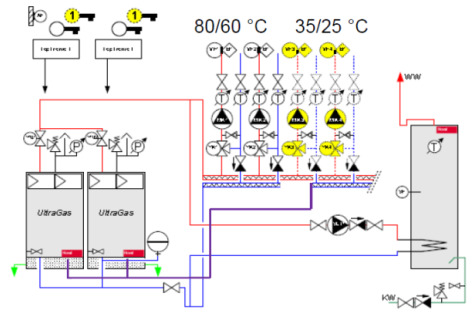
System Hoval UltraGas 2
Flexibility and design reliability thanks to compatibility with future energy sources
The Hoval UltraGas 2 gas condensing boiler can be fuelled by the following energy sources:
- Natural gas
- Natural gas containing up to 20 per cent hydrogen
- Liquid gas (liquefied petroleum gas – LPG) and bio-LPG
- Biomethane up to 100 per cent (EN 16723)
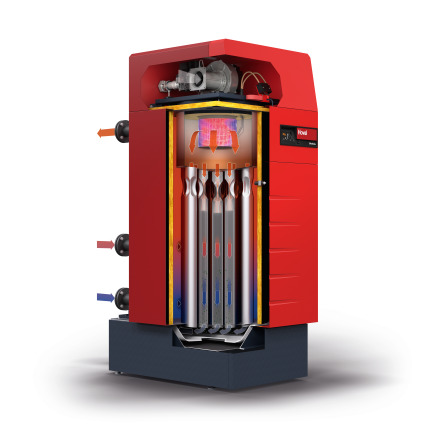
TurboFer technology for high system efficiency
TurboFer technology for high system efficiency in existing buildings
At the heart of the UltraGas 2 is the TurboFer heat exchanger. Its high efficiency is based on:
- Optimised airflow
- The high thermal conductivity of aluminium
- A large heat transfer area thanks to the special fin system
Hydraulic benefits through optimised temperature stratification
The vertical design of the heat exchanger, the high water content and the low flow velocities result in natural temperature stratification. This stratification effect supports the hydraulic stability of the system and counteracts load-induced temperature fluctuations. The result is optimum operating conditions for high calorific value utilisation and cost-effective plant operation.
Advantages:
- Improved heat utilisation
- Greater system efficiency
- Low hydraulic resistance
- Stable operating conditions with varying return temperatures
Advantages of the Hoval UltraGas 2 in challenging refurbishment projects:
- Flow temperatures up to 95 °C
- Compact design
- Small footprint
- Simple hydraulic integration
- Low pressure losses
- Optimum integration into hybrid systems with heat pumps
Case study: hybrid heating system using UltraGas 2 in an existing building
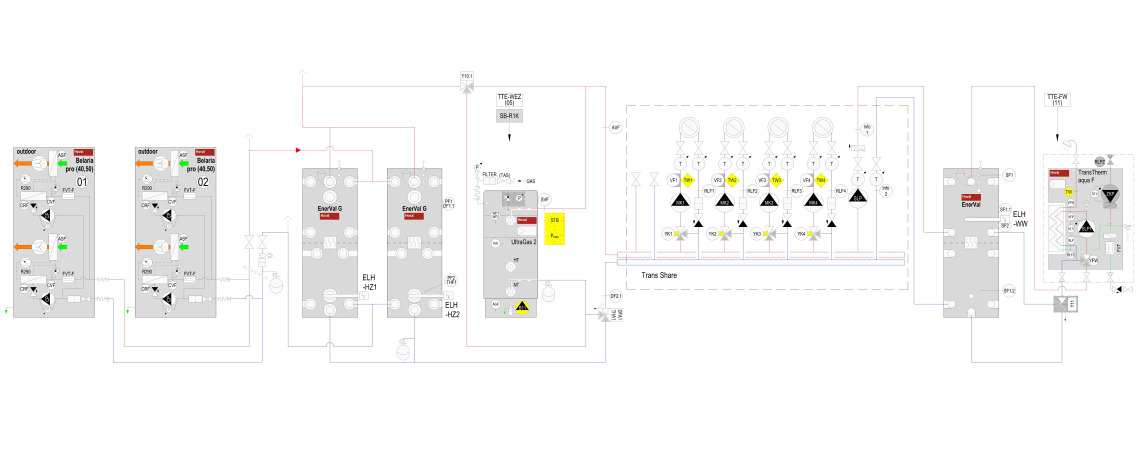
A Hoval modernisation project at an animal shelter in Nuremberg demonstrates how the combination of electric heat generation and fuel-flexible peak load coverage can be implemented in practice. The existing heating system, comprising three outdated oil-fired boilers, had reached the end of its technical service life. At the same time, there was no piped gas infrastructure at the site.
From a planning perspective, the decision was made to opt for a hybrid heating system.
The base load is handled by a cascade of two Belaria pro air-to-water heat pumps with a total output of around 96 kW. The systems were designed for flow temperatures of up to 60 °C and could therefore be integrated into the existing heating distribution system.
An UltraGas 2 gas condensing boiler is used to cover peak demand; it is supplied by an underground 6,400-litre liquid gas tank. The system is designed to run on both conventional liquid gas (liquefied petroleum gas – LPG) and bio-LPG.
Two EnerVal G buffer storage tanks, each with a capacity of 1,000 litres, were installed for hydraulic decoupling and energy storage. An UltraGas 2 unit with an output of 300 kW was also incorporated to cover peak loads. As a result, the heat pump system was able to be optimised for cost-effective operation, whilst the condensing boiler was able to reliably meet high demand requirements.
Domestic water is heated using a TransTherm aqua F fresh water station.
All system components are co-ordinated by means of the Hoval TopTronic E system control unit, ensuring that heat pumps, storage tanks and condensing boilers work together as part of a single control strategy.
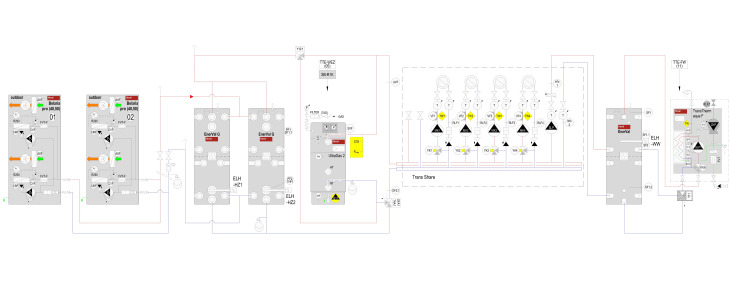
System technology | Animal Shelter Nuremberg
Related Webinar
Direct link to the webinar with more information:
On-Demand: Alternative gases in building planning – options, availability and planning perspectives
Agenda:
- Market overview & classification
- Availability & security of supply
- Perspectives relevant to planning
- Gas-based system solutions in buildings
- Practical example: Hoval UltraGas 2 in use
- Q&A
Your Hoval contact will be happy to provide you with further information and individual consulting!